


The Energy Minister’s calm approach
for 5 dager siden

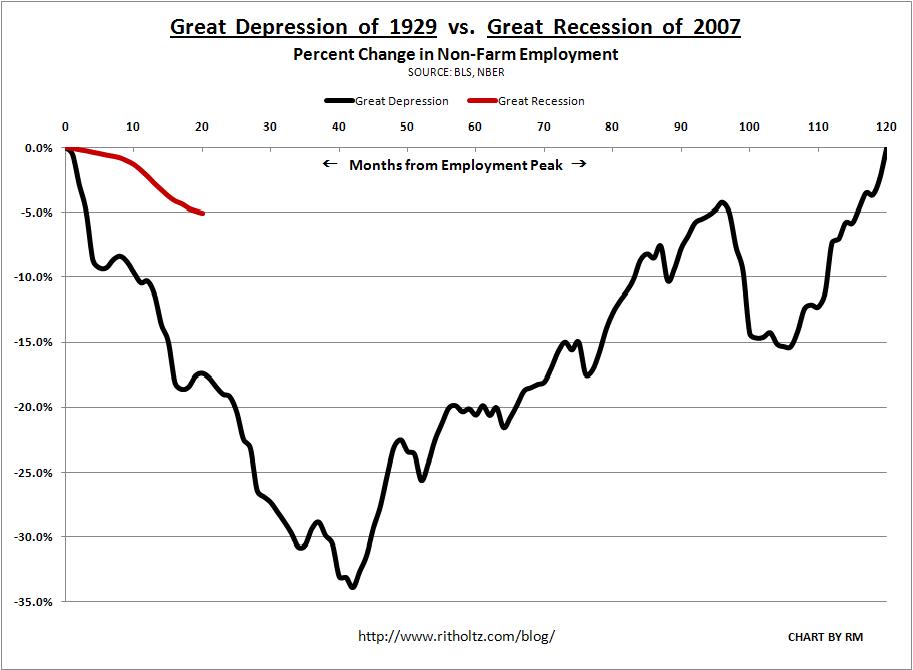
At the same time the supposed "official" statistics say we lost 216,000 jobs. Unfortunately the household survey, in the same release, says something different. Their "official" numbers on the household survey say 466,000 fewer people were working, not 216,000. But it gets even worse than that when you dig into the actual data.
If you look on page 10 in the Household Survey you see the line "Employed." July to August that number declined not 216,000, not 466,000, but a staggering nine hundred and eighty-one thousand people.
So where did the rest go? They gave up. Note that the counted "unemployed" actually fell by 378,000 people. Those are people who simply aren't looking any more - they have deduced that there is no point to searching for a job.
The BLS doesn't count those people as "unemployed" but the merchant on the corner and the bank next door sure as hell do.
I believe the brain trust behind the Obama White House has made a huge tactical error.
As Rahm Emmanuel likes to say, one should "never waste a crisis" — and the White House has done just that.
There was a narrow window to effect a full regulatory reform of Wall Street, the Banking Industry and other causes of the collapse. Instead, the WH tacked in a different direction top pursue healthcare reform.
This was an enormous miscalculation.
Unfortunately, it is impossible to verify that genetically modified crops perform as advertised. That is because agritech companies have given themselves veto power over the work of independent researchers.
To purchase genetically modified seeds, a customer must sign an agreement that limits what can be done with them. (If you have installed software recently, you will recognize the concept of the end-user agreement.) Agreements are considered necessary to protect a company’s intellectual property, and they justifiably preclude the replication of the genetic enhancements that make the seeds unique. But agritech companies such as Monsanto, Pioneer and Syngenta go further. For a decade their user agreements have explicitly forbidden the use of the seeds for any independent research. Under the threat of litigation, scientists cannot test a seed to explore the different conditions under which it thrives or fails. They cannot compare seeds from one company against those from another company. And perhaps most important, they cannot examine whether the genetically modified crops lead to unintended environmental side effects.
Research on genetically modified seeds is still published, of course. But only studies that the seed companies have approved ever see the light of a peer-reviewed journal.
"You start off with these huge national networks that are really big, quite dense," Glattfelder said. “From that you're able to ... unveil the important structure in this original big network. You then realize most of the network isn't at all important."
The most pared-down backbones exist in Anglo-Saxon countries, including the U.S., Australia, and the U.K. Paradoxically; these same countries are considered by economists to have the most widely-held stocks in the world, with ownership of companies tending to be spread out among many investors. But while each American company may link to many owners, Glattfelder and Battiston's analysis found that the owners varied little from stock to stock, meaning that comparatively few hands are holding the reins of the entire market.
“If you would look at this locally, it's always distributed,” Glattfelder said. “If you then look at who is at the end of these links, you find that it's the same guys, [which] is not something you'd expect from the local view.”
In substantial measure, the food crisis plaguing much of the South and the financial crisis of the North have a common source: the shift toward neoliberalism since the 1970s, which brought to an end the Bretton Woods system instituted by the United States and United Kingdom after World War II. The architects of Bretton Woods, John Maynard Keynes and Harry Dexter White, anticipated that its core principles—including capital controls and regulated currencies—would lead to rapid and relatively balanced economic growth and would also free governments to institute the social democratic programs that had very strong public support. Mostly, they were vindicated on both counts. Many economists call the years that followed, until the 1970s, the “golden age of capitalism.”
The “golden age” saw not only unprecedented and relatively egalitarian growth, but also the introduction of welfare-state measures. As Keynes and White were aware, free capital movement and speculation inhibit those options. To quote from the professional literature, free flow of capital creates a “virtual senate” of lenders and investors who carry out a “moment-by-moment referendum” on government policies, and if they find them irrational—that is, designed to help people, not profits—they vote against them by capital flight, attacks on currency, and other means. Democratic governments therefore have a “dual constituency”: the population, and the virtual senate, who typically prevail.
Large-scale state intervention in the economy is not just a phenomenon of the post-World War II era, either. On the contrary, the state has always been a central factor in economic development. Once they gained their independence, the American colonies were free to abandon the orthodox economic policies that dictated adherence to their comparative advantage in export of primary commodities while importing superior British manufacturing goods. Instead, the Hamiltonian economy imposed very high tariffs so that an industrial economy could develop: textiles, steel, and much else. The eminent economic historian Paul Bairoch describes the United States as “the mother country and bastion of modern protectionism,” with the highest tariffs in the world during its great growth period.
Det siste året har oljeselskapene droppet investeringsprosjekter over en lav sko. Men kuttene er ikke begrenset til olje.
- Både i kull og gass, og ikke minst innen fornybar energi, er investeringene redusert kraftig, sier Saltvedt.
Hun mener derfor en storstilt og verdensomspennende energikrise er sannsynlig i løpet av noen år.
Prognosen viser en avtagende oljeproduksjon hvert eneste år i den kommende femårsperioden, og nedgangen er om lag 10 prosent større enn tidligere forutsatt.
The conclusion from the forecast is that Norway will barely be an oil exporter by 2030, with only a few hundred thousand barrels of oil available for export in the best case. This will have dramatic consequences for the Norwegian economy and for the world, as Norway presently is the world third largest oil exporter.


 Innlegg
Alle kommentarer
Innlegg
Alle kommentarer


